

July 1, 2017
The Curator’s Log: Herreshoff and US Naval Torpedo Station Newport
Developing the Torpedo Boat as a Weapon

Originally Published July 2017
In Memory of Richard V. Simpson
October 31, 1935 – July 4, 2017
Bristol Author & Historian
Introduction
Goat Island and the U.S. Naval Torpedo Station (2016) is the most recent and last book authored by Bristol historian and good friend of the museum, Richard Simpson. It covers a century of the station's history from its founding in 1869. Richard's book is based upon 30 years of personal research and collecting of materials about the station, his prior book, Building the Mosquito Fleet: U.S. Navy's First Torpedo Boats (2001) and official Navy histories of the station.
One of the most active periods at the Torpedo Station was from 1890 to 1897 when the U.S. Navy's only two torpedo boats, both built by Herreshoff, were testing the first automobile torpedoes and developing tactics for their employment. This paper is a summary of what transpired in those years.1
The New American Navy, the Torpedo Station and the Torpedo Board
Following the Civil War the US Navy experienced a period of regression back to the days of sail known as the "doldrums". One of the few bright spots was the 1869 founding of Torpedo Station Newport with responsibility for development of torpedoes and torpedo boats. Movement to build a new steel navy, including torpedo boats, commenced in March 1883 with authorization for the construction of the ABCD ships- three steel-hulled protected cruisers, ATLANTA, BOSTON and CHICAGO and the dispatch vessel DOLPHIN.
Progress was slow in the early years as it took time to develop domestic sources for steel alloys, armor and armaments; by March 1889 only three new steel vessels had been delivered. Congress maintained tight control of the authorization, funding and expenditures under a new closely monitored account- "Increase in the Navy." There were calls to build steel cruisers, battleships and 20 to 30 torpedo boats.2 The torpedo boats were part of the Atlantic and Gulf coast harbor defense capability proposed in response to studies conducted by the Naval War College.3 But without a workable automobile (self-propelled) torpedo it was a hard sell. As the Secretary of the Navy reported in 1890:
"This country has been thus far absolutely without a successful automobile torpedo…Vague hopes and expectations that something will turn up gradually fixed themselves upon the Howell torpedo as the probable solution of the problem, although it was still in experimental stage."
A Torpedo Board of Ordnance officers led by Commander George A. Converse was established at the Torpedo Station to fix the problem and speed the development of torpedo boats through experimentation and training. Converse was no stranger to Newport or the Herreshoff Manufacturing Co. (HMCo.); in May 1876, he had conducted the acceptance trials of the Herreshoff record setting 20.3 knot spar torpedo boat LIGHTNING (HMCo. #20). During his time in Newport he was also assigned officer-in-charge of the Torpedo Station (1893) and over saw the construction of HMCo.'s next two torpedo boats PORTER (TB-6) and DUPONT (TB-7).
The Herreshoff Torpedo Boats
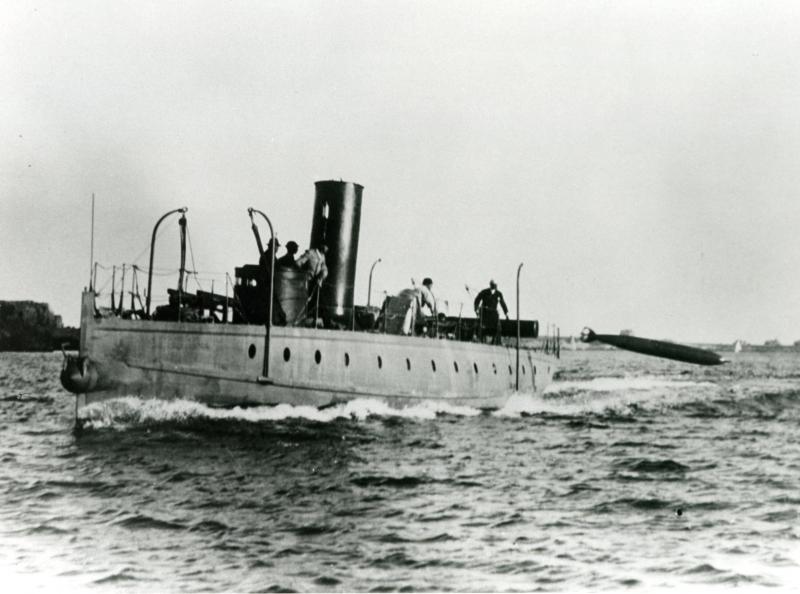
STILETTO (WTB-1)
- In 1887 Congress authorized the Navy to acquire the 94-foot, 28-ton STILLETTO (HMCo. #118) for "experimentation purposes." Designed by Capt. Nat Herreshoff in 1885 as a "Torpedo boat type- fitted as yacht" she was wood–planked on steel frames, and achieved 26.5 knots in trials. The navy's acquisition was influenced by her well- publicized defeat of the larger Hudson River steamer MARY POWELL. The conversion to a torpedo boat added considerable weight resulting in a reduced top speed of 19 knots; one knot better than that required for torpedo firing trials. Subjected to "unremitting hard service", STILETTO and her machinery performed well. In 1892 STILETTO now fitted with launch tubes (one bow & one turntable on deck aft) to qualify the Howell torpedo was considered more than an experimental vessel, but "now really a torpedo boat, capable of servicing war."
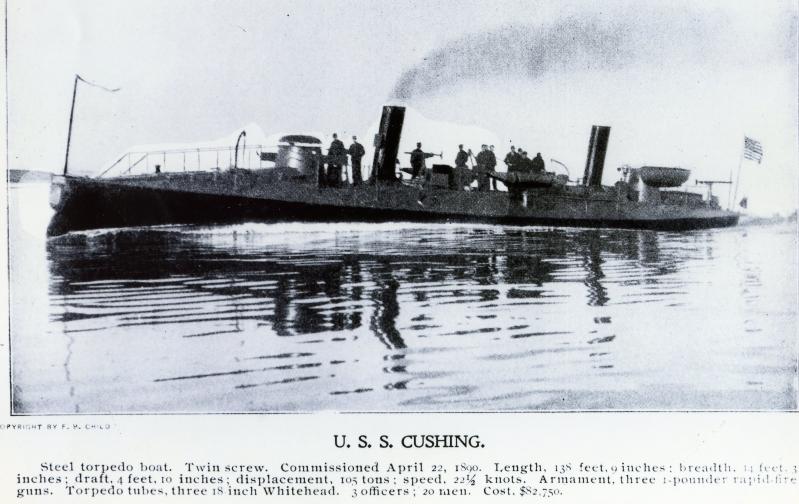
CUSHING (TB-1)
- In 1886 Congress authorized the construction of the first US steel sea-going torpedo boat. The vessel was designed by Capt. Nat to meet the requirements of a short twenty-odd page circular of requirements and specification. The resulting 137-foot, 105-ton CUSHING (HMCo. #152) achieved 22.5 knots in trials. The Navy trials board found that although the first to be built in the US, CUSHING "compares favorably with the best results obtained abroad after years of experience in similar work." Delivered to the Navy in April 1890, CUSHING was assigned to the "Squadron of Evolution" where the Navy experimented with this first-of-its-kind until January 1892 when she was assigned to the Torpedo Station to test and qualify the Whitehead torpedo. Whitehead torpedo launch tubes became available and were installed in July 1892.
The Torpedoes
A number of different designs were considered and tested by the Navy through 1894 including a rocket torpedo and an electric torpedo. Only two were selected for full development, qualification testing and production.
Howell Torpedo
- Description- The propeller-driven Howell torpedo, first patented in 1871, was powered by a heavy flywheel that was spun up by a shipboard auxiliary steam turbine prior to launch. By 1888 prototypes had demonstrated a range of 600 yards, achieving 24 knots over the first 200 yards and good directional stability due to the gyroscopic action of the flywheel. Its advantages over the Whitehead torpedo were a wakeless trajectory, lighter weight, and greater explosive charge. Its principal disadvantage was that the flywheel had to be kept running at full speed when an enemy was encountered and this time was limited by oil supply to about 30 minutes.4
- Production- In January 1889 the Navy placed a production order with the Hotchkiss Ordnance Co. of Providence for 30 Howell torpedoes, with 10 to be delivered by July 1890. Production delays, torpedo losses in preliminary trials and redesigns required by early failures mounted. By 1893 only 7 had been presented for official trial. In the following year 21 were ready for the official trials, with only 2 accepted. Eventually 50 were delivered before the decision was made in 1897 to produce only the Whitehead torpedo.
- Trials- All Hotchkiss preliminary trials and the official navy acceptance trials were conducted by STILETTO on a company test range in Tiverton north of the railway bridge. Trials tested the torpedo, launching apparatus and handling equipment. STILETTO was in constant use in 1892 conducting tests perfecting the Howell torpedo. Torpedo Board acceptance trials began July 15, 1893 and continued as Howell torpedoes became available. Each torpedo was tested for speed and accuracy for a range of 400 yards when launched from STILETTO steaming at 18 knots. Special noise tests were run in 1895 to determine whether the noise of the auxiliary turbine and spinning flywheel could be detected before that of STILETTO's underway noise; it could not. When not conducting trials or training STILETTO was used for special operations such as 12-hour high-speed trips delivering 2 tons of smokeless powder to New York ammunition depots. No tests were run in the winter when STILETTO was usually hauled at the Station for maintenance. Significant repairs included boiler replacement in 1891 and periodic tube repairs.
Whitehead Torpedo
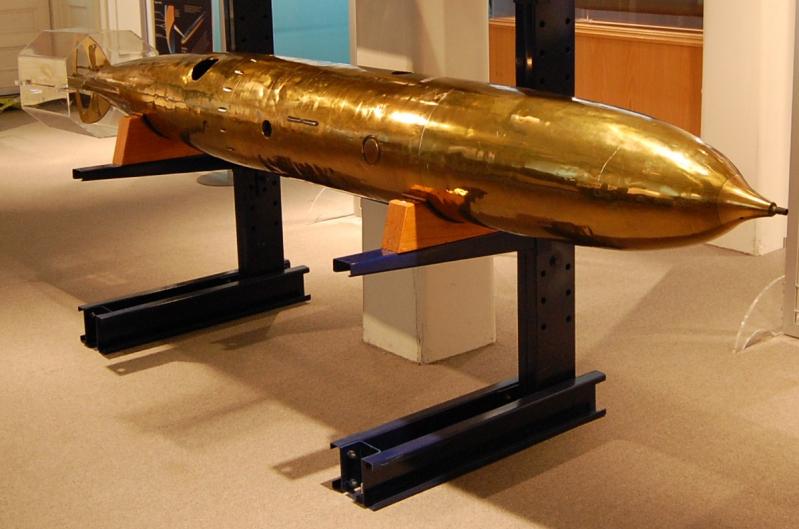
- Acquisition- Concerned with delays in the production of the Howell torpedo the Navy arranged with the Whitehead Torpedo Company of Fiume Austria for an American company to manufacture the torpedo under license and agreed to a royalty on each torpedo for 15 years. In 1891 the E. W. Bliss Company of Brooklyn, NY obtained a patent, plans, and working models of the torpedo and launching apparatus as well as a Navy order for 100 torpedoes, with deliveries to start November 1891 at the rate of 10 per month.
- Description- The propeller of the Whitehead torpedo was driven by a reciprocating engine powered by a compressed air flask. An air compressor was placed onboard the launching vessel to charge the flask. Heavier, larger and more costly than the Howell it had become the standard torpedo throughout Europe. Initial models achieved 23 knots over a range of 600 yards.5
- Production- Bliss experienced delays in obtaining a suitable forged air flask. By October 1893 the Navy had accepted 28 torpedoes and the following year the remainder of the 100 were accepted. The Navy placed follow orders for models of different lengths and diameters, increased explosive weight, a turbine rather than reciprocating engine and improved accuracy.
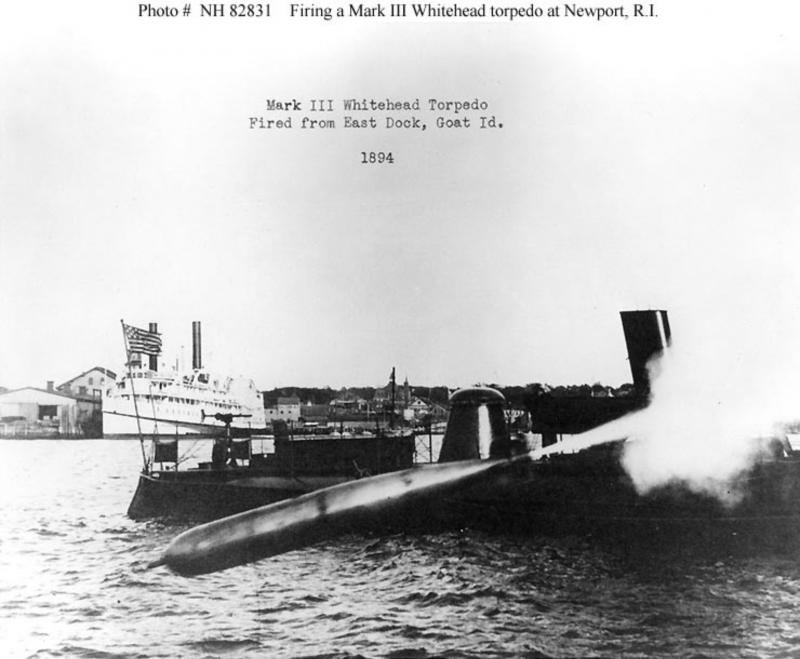
- Trials-Bliss established a test facility in Noyack Bay on the eastern end of Long Island. CUSHING's experiments with the Whitehead torpedo began September 1892 and Navy acceptance trials the following May. CUSHING conducted both preliminary and acceptance trials. CUSHING was fitted with a bow tube and twin tubes on centerline aft, mounted on a common turntable. The latter was later changed to port and starboard single trainable tubes; this became the standard for following boats. For acceptance each torpedo had to meet the accuracy and speed specification in three out of five consecutive runs. Bliss received a relaxation of accuracy for the first 10 torpedoes; the subsequent 90 met the following specification:
- Accuracy- A deviation of not more than 8 yards right or left at 400 yards, and 24 yards at 800 yards. Limit from set depth not to exceed 15 inches at both ranges.
- Speed- Mean speed of three runs of 800 yards to be at least 26.5 knots; one additional 400 yard run to be at least 30 knots.
CUSHING remained heavily involved in torpedo acceptance trials through 1896. Each winter CUSHING was usually hauled for maintenance at the Washington Navy Yard.
Torpedo Boat Operations and Tactics
Night Maneuvers of a Torpedo Boat: The best condition for a torpedo boat attack was at night and experiments were run to determine the best color and tactics for greatest success. STILETTO and CUSHING were originally painted a dark olive green similar to that used abroad; then CUSHING was lightened from time to time for comparison. Returning to Newport at night from Noyack Bay CUSHING often ran simulated attacks while attempting to avoid being spotted by searchlights on Fort Adams, warships at anchor and the Torpedo Station. In 1893 experiments CUSHING was able to get within torpedo range of an alerted cruiser and even to its own mooring without detection. Conclusions drawn from these experiments were incorporated into doctrine and the curriculum of the Torpedo School.
Developing a Torpedo Boat Cadre: Converse and members of the Torpedo Board instructed at the War College and the Torpedo School. Officer students boarded STILETTO and CUSHING to witness and conduct torpedo runs under service conditions.
Improving Torpedo Accuracy: Hand held devices such as a torpedo director were developed and tested to aid aiming the torpedo tubes prior to launch.
Assessing foreign torpedo handling & launching capabilities: CUSHING and members of the Torpedo Board participated in the April 1893 International Naval Rendezvous and Review, starting at Hampton Roads and sailing as a 35-ship fleet to New York, to assess the torpedo launching and handling capabilities of the foreign warships.6
Pathfinding Torpedo Boat Transit the Length of the Atlantic Coast: In spring 1895 CUSHING transited from Wash. DC to Jacksonville FL "through the rivers and canals",exploring a route to be used in time of war.
Conclusion
By the time George Converse detached from Newport on June 15, 1897 the basics for a competent modern torpedo force had been established.7 Scores of officers trained, doctrine developed, torpedo systems proven in hundreds of torpedo launchings, and nearly 350 torpedoes accepted and in inventory. The Navy was ready to employ its 19 new torpedo boats; 3 delivered and 16 building.8 It had all been done by a small group of officers in Newport aided by two reliable Herreshoff designed and built torpedo boats
John Palmieri
1 Primary sources for this paper are the Annual Reports of the Secretary of the Navy, 1890-97. Included within the annual compilation, are reports to the Secretary from each Bureau, and lesser commands including US Naval Torpedo Station Newport, the Torpedo Board, and Newport's Naval War College and Torpedo School.
2 By 1890 England and France each had about 200 torpedo boats; Spain and Brazil had 15.
3 British naval maneuvers in 1893 demonstrated that torpedo boats defending a port against cruisers and battleships extracted losses upon the attacker of 6 times in men and 4 times in cost of vessel damage.
4 Thomas Wildenberg & Norman Polmar, Ship Killer: A History of the American Torpedo. Naval Institute Press, Annapolis, MD. 2010 pages 20-23.
5 Ibid. pages 19-31
6 All navy's including the US, were fitting battleships, cruisers and gunboats, as well as torpedo boats, to launch torpedoes.
7 In the 1896 Annual Report Secretary of the Navy Herbert cited Converse for his "remarkable knowledge of his specialty and business capacity." He was the only officer meritoriously cited in the report.
8 Herreshoff built five of the nineteen, the most of any builder.