

October 22, 2025
A Small Fleet of Sailing Craft: Clarence Herreshoff’s Guiteras Skiffs
A guest post on a once-forgotten Herreshoff one-design class

By Charles M. Flanagan
The popularity of car rides and motorboat races deflated the enthusiasm that had buoyed the growth of middle-class sailboat racing during the turn-of-the-20th-century decades. By 1910 motorboat racing ruled Narragansett Bay. World War I burst this bubble of fast boat popularity, however, as wartime restrictions halted all racing on the Bay from 1918 – 1919. As Providence Journal Yachting Editor Arthur W. “Jeff” Davis said in his classic 1946 history, Yachting in Narragansett Bay, “active yachting in Narragansett Bay passed out of the picture with the end of the season of 1917… I found no yachting news in the files of the Providence Journal for the next two years.” A search of period newspapers in Fall River, Providence, and Bristol during the war years, showed yacht clubs serving as venues for dances, games of whist, and Red Cross activities, leaving sailors hungry to reestablish boat racing.
Immediately after the war, the Spanish Influenza pandemic and post-war economic recession slowed the return to what people referred to as normalcy, a time anticipated by people around the shores Narragansett Bay as when they could get back to the watersports they loved. In an age before boats were mass produced, the solution to the challenge of jump-starting racing was often a locally designed, small boat that could quickly get a club back in the game. In Bristol, Rhode Island, post-World War I sailboat racing was revived, in part, by using the Guiteras Skiff, a locally designed and produced small boat that enjoyed a brief moment of popularity before disappearing into oblivion.
The Guiteras or Bristol Yacht Club skiff was an unballasted, approximately14’ long by 5’ wide open boat with a short leg-o’-mutton, cat rig. Equipped with a centerboard, rudder, and thwarts for seating, it was a simple, undecked boat created for racing in Bristol Harbor. The boat was designed in 1920 by Clarence Herreshoff, perhaps in collaboration with his brother L. Francis. A newspaper item from 1922 credits the design to Clarence, but a later news story named Francis as the designer. The mystery of who actually designed the skiff remains shrouded in ambiguity because the sail plan for the boat is preserved among the papers of L. Francis Herreshoff preserved at Mystic Seaport Museum.
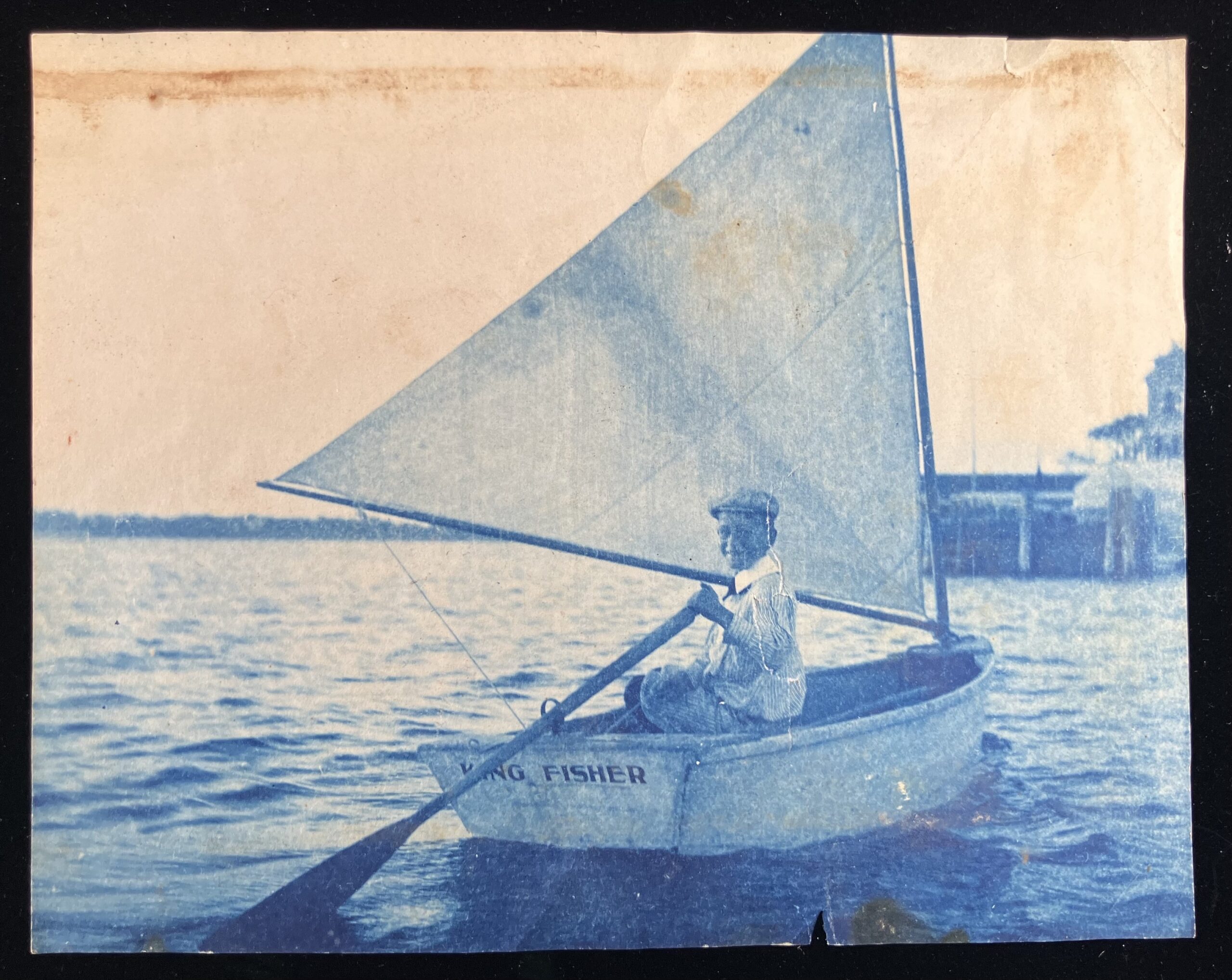
Clarence Herreshoff was the youngest son of the famous yacht designer, Nathanael G. Herreshoff and brother of the well-known designers L. Francis, and Sidney D. Herreshoff. Clarence was born in 1896, and a young Brown University graduate in 1920. His work on this skiff preceded a long career as a designer of naval ships at several major ship yards and as a division head at the Navy Department’s Bureau of Ships. This early skiff design might have involved collaboration with his brothers. Francis was then teaching mechanical drawing in Bristol, and he possibly created the drawing of the skiff’s sail plan now archived among his papers held at Mystic Seaport Museum. (Ships Plans SP.38.235)
The yacht club received the funds that launched the skiffs via a $5,000 bequest from the will of the late Dr. Ramon Guiteras who died in 1917. Dr. Guiteras was a native of Bristol. His father, Dr. Ramon Guiteras, Sr. was a Spanish aristocrat who practiced medicine in New York, but also owned property in Cuba. His mother, Elizabeth Wardwell, was a member of a prominent Bristol family that operated a lumber business and boatyard. After receiving his primary education in Bristol schools, the younger Dr. Guiteras attended prep schools in Providence and Boston to ready himself for admission to an elite college. He was admitted to Harvard College, graduating in 1883, a classmate and friend of Theodore Roosevelt. He then attended and graduated from Harvard Medical College.
Dr. Guiteras shared the passion for physical fitness that Roosevelt would famously describe in his writing as living “the strenuous life.” While at college, Guiteras dedicated himself to boxing and became a highly regarded heavyweight. On one noted occasion, he squared off against John L. Sullivan, the first Heavyweight Champion of the World. It is reported that Guiteras knocked Sullivan down, touching off a fierce, extended exchange of blows during which neither could make the other submit. (New York Herald 1/25/1891)
In his professional life, Dr. Guiteras was a pioneer in the field of urology and the founder of the American Urological Association. He was a leading specialist in treating prostate-related ailments and published several papers and books on the subject. His national leadership in his specialty was celebrated by the American Association of Urologists’s naming a major award in his honor. Dr. Guiteras was also an expert on public health. President Roosevelt, and later President Wilson, sent him as an emissary to investigate public health conditions in Cuba. (The New York Times 12/14/1917)
Consistent with his advocacy of the strenuous life, Dr. Guiteras was an avid outdoorsman and big game hunter. In August 7, 1886, the New York monthly magazine, The Journalist, reported that Dr. Guiteras had accompanied poet and Irish independence activist, John Boyle O’Reilly on the latter’s annual canoe and camping trip. Dr. Guiteras was also a leading big game hunter who went on several African safaris. On January 6, 1910, The Frontier newspaper of Holt County, NE identified Dr. Guiteras as the President of the highly exclusive Big Game Club of New York. According to a 1918 article in the Alaska newspaper, the Seward Gateway, the clubhad been founded in 1887 by Theodore Roosevelt. The Frontier had stated that to be eligible for membership, a hunter must have shot a lion, elephant, buffalo, or rhinoceros in Africa. Dr. Guiteras was also involved in yachting and was named the Fleet Doctor of the Atlantic Yacht Club of New York, then one of America’s most prestigious clubs.
The link between Dr. Guiteras’s legacy and the Bristol Yacht Club is not explicit. but an 1896 news article suggested that he was long-time supporter of the club. On August, 14 of that year, the Providence News reported on a regular meeting of Bristol’s Neptune Boat Club – an organization that was later renamed as the Bristol Yacht Club. Dr. Guiteras, and other men, whose sons would later sail Guiteras Skiffs, were listed as new members. While Dr. Guiteras was professionally based in New York, society items in Rhode Island newspapers showed that he maintained his Bristol roots through regular summer visits. The major bequest in his will honored his mother by leaving $150,000 to the Town of Bristol for the purpose of constructing a school bearing her name. The Guiteras School was built in the early 1920s and served students of the town for over a century.
News coverage of the Guiteras Skiffs began in the “Bristol County News” section of the Providence Journal on January 6, 1918. The article was headlined, “Bequest Made by Dr. Guiteras of New York Appreciated: Gap Filled at the Club.” A subtitle continued, “Provision for Small Craft for Guests Covers Want Long Felt by Members.” The piece began by saying, “Of especial interest in Bristol is the bequest of the late Dr. Ramon Guiteras of New York providing for a fleet of small pleasure craft to be attached to the Bristol Yacht Club, for which purpose the doctor bequeathed a substantial sum of money. The plan is one that appeals to members of the yacht club, for it is recognized as a substantial benefit to the organization and one that will fill a gap noted by Dr. Guiteras long ago. So far as known, the craft will consist of sail and row boats, such as will afford pleasure to the guests of the club on summer afternoons. The little craft may be taken care of by the house committee, in connection with the clubhouse and pier.”
The same newspaper reported on February 15, 1920 that a committee had been formed at the Bristol Yacht Club to plan the “acquisition of a small fleet of sailing craft for the use of Club members in pursuance of a bequest in the will of Dr. Guiteras.” Two months later, the Journal reported that the club was planning to use interest income from the $5000 it had received from Dr. Guiteras to purchase “one or two boats.”
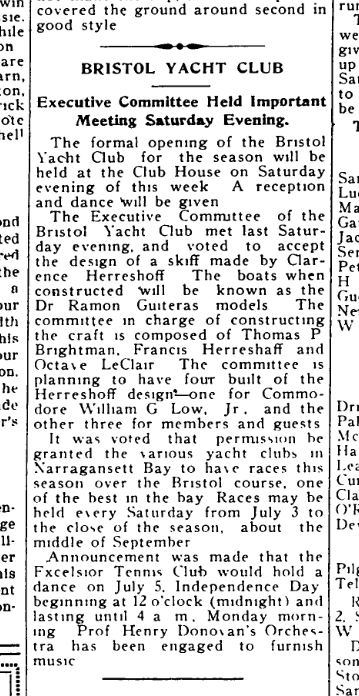
The Bristol Phoenix reported on June 22, 1920 that the Executive Committee of the Bristol Yacht Club had recently voted to accept a design for a skiff by Clarence Herreshoff to be known as a Guiteras Skiff and that four boats would be built to the design. Six days later, the Providence Journal also named Clarence Herreshoff as the designer of four skiffs to be built by the Bristol Yacht Club and by individual members. The article also noted that the skiffs would be constructed by S. L. Wardwell and that the project would be overseen by a committee of the club consisting of Clarence Herreshoff, Thomas P. Brightman, and Octave LeClair.
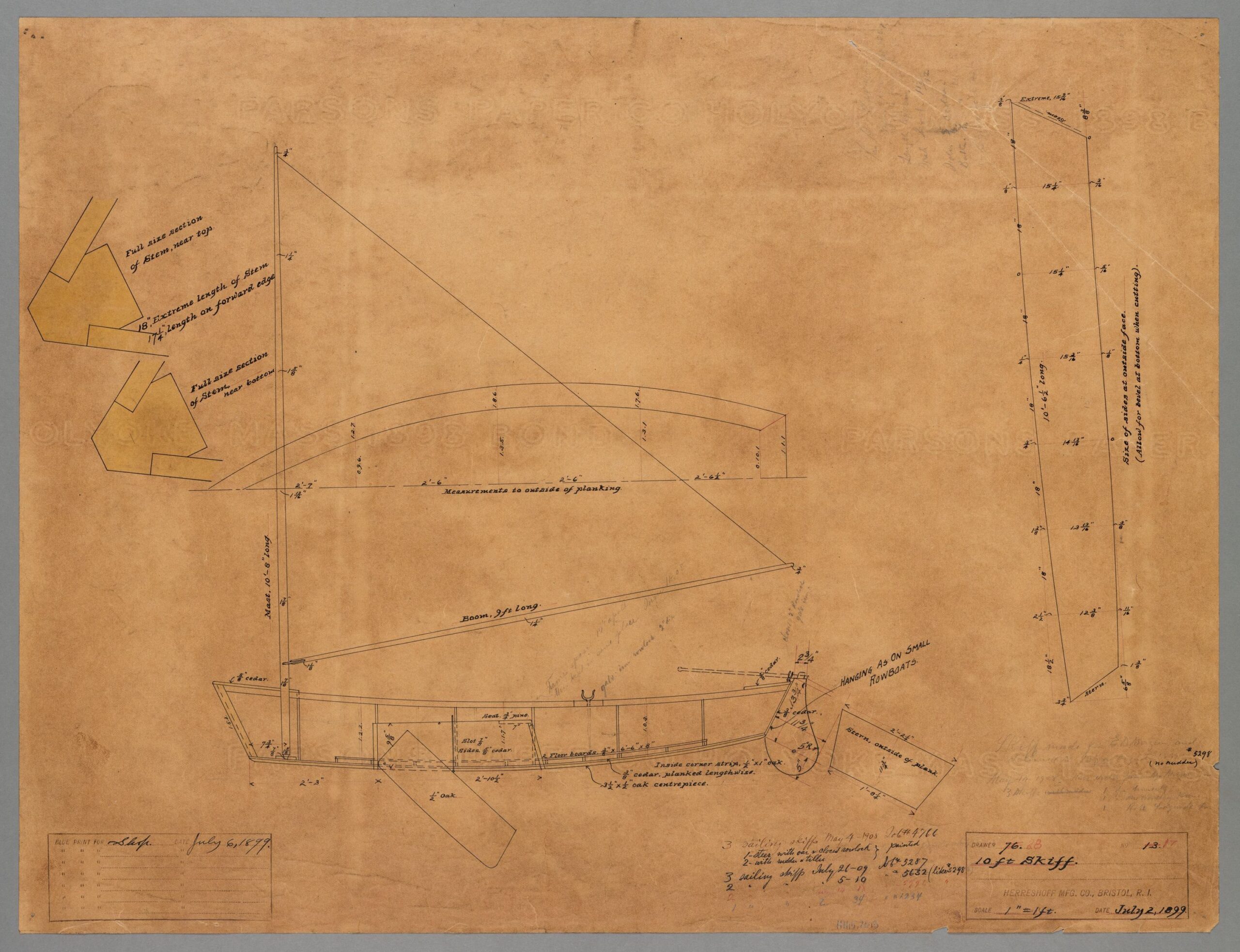
The hard-chined, cat-rigged skiff was not a complete novelty. Similar boats can be identified in designs by the Herreshoffs, and among contemporary and regional skiffs. Visually, the closest analogue is a 10’ skiff designed by Nathanael Greene Herreshoff in 1899. Similar to the Guiteras Skiff, this boat is an undecked, hard-chined straight-sided skiff. The Guiteras Skiff was distinct in being 14’ long and having two planks on each side.
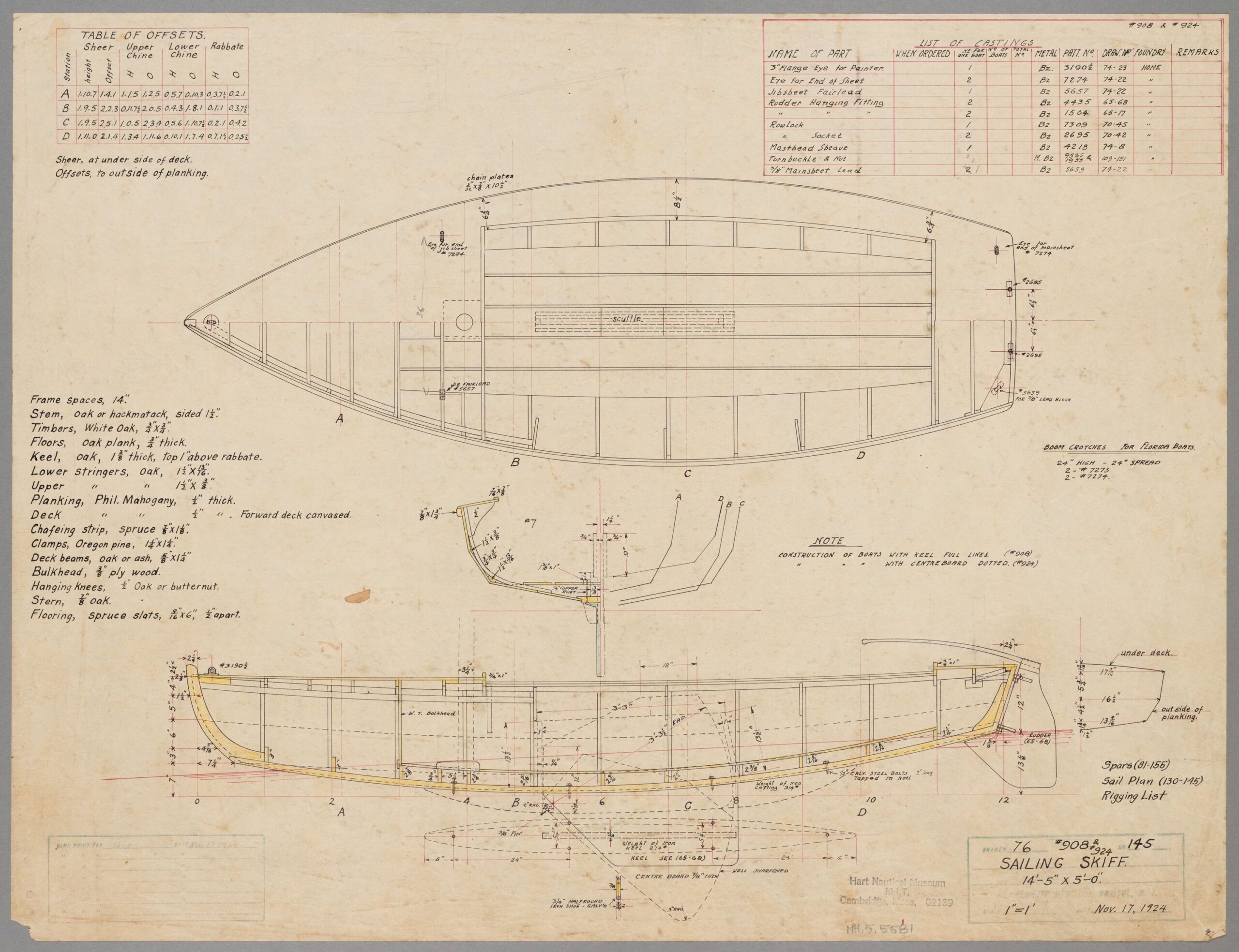
L. Francis Herreshoff designed a skiff in 1924 that appears to be a refinement of the Guiteras Skiff with a sloop rig and a foredeck. The improvements made in this more substantial boat were perhaps engineered to address limitations of the Guiteras Skiff.
Two local examples demonstrate suggest a shared interest in small catboats, but division about whether a round-bottomed hull similar to the traditional Cape Cod cat was preferred or a hard-chined hull, perhaps derived from the success of the Star class. The 12’ Beetle Cat, first designed in 1921 had a traditional, round bottom. The 13’ Candy Class skiff, designed by T. Elton Wood in Tiverton, RI in 1921 had a hard-chined hull.

News of the first race between two of the Guiteras skiffs was reported by the Bristol Phoenix on August 17, 1920. In this piece, the skiffs were described as being 15 feet long. The rival skiffs were skippered by W.G. Low, Jr. and Charlie Potter. Both the rudder and the boom on Potter’s boat broke during the race, but the skiff’s resourceful crew finished the contest by holding the broken gear in place. Three days later, the Phoenix reported that “two of the seven Guiteras Memorial skiffs” had been built for the Bristol Yacht Club, suggesting that the fleet would number more than four boats.
An article published in the Providence Journal on April 21, 1921 looked back to the previous fall’s sailing in the skiffs, noting that seven boats had competed in informal races. The skiffs were said to have “put up some pretty hot scraps over the short courses before cold weather ended the competition.” The article continued that, “the skiffs are all built on the same design, and the prospects are good that quite a few new ones will be built for the class before the season opens.” Looking ahead to the upcoming season, the Journal reported that the Club planned weekly races with the champion receiving a cup donated by Commodore William Gilman Low, Jr.
In his summary of racing on the Bay during 1921 Jeff Davis said, “At Bristol, a group of five Guiteras skiffs were racing nearly every Saturday.” According to a July 8, 1921 Bristol Phoenix article, the first official race in the skiffs was held on July 9, 1921 and this contest would be followed by a series of Saturday afternoon races occurring until August 27. The skiffs would be sailed as a one-design class on a course starting at the club house (located at the foot of Constitution St.) and proceeding to Middle Ground buoy and on to the Usher’s Point buoy, then back to the start for a second lap finishing from south to north at the club house. On October 4, 1921, the Phoenix described two laps around this course as being a distance of seven miles.
The earliest published race results appeared in the Bristol Phoenix issue of July 12, 1921. In this contest, Julep, sailed by Wallace E. Howe finished first, completing the course in 62 minutes. (The short elapsed time raises questions about the length of the course sailed in this race.) The Daiquiri, sailed by W.G. Low, finished six minutes and 25 seconds later. George Moore sailed a skiff named BYC, owned by the club, to a third-place finish, while Camouflage, sailed by J. Winthrop “Jack” DeWolf, Jr. finished fourth.

The Providence Journal published a drawing of the Guiteras skiff on July 17, 1921. The caption under the image described the boat as the lines of the “popular Bristol Yacht Club’s 14-foot skiff” and noted that there were seven boats in the fleet.
The skiffs next attracted press coverage on August 2, 1921 when the Bristol Phoenix reported on a race held at the Bristol Yacht Club in a stiff 15 mph. breeze over a 10-mile triangular course. The BYC sailed by “Gid” Herreshoff led the way, but the closest contest was a three-way battle for second place involving Julep, Camouflage, and Daiquiri. Julep, sailed by Wallis E. Howe, Jr. finished second; Daiquiri sailed by Norman Herreshoff was third; and Camouflage, sailed by Clarence Herreshoff finished fourth. An unnamed boat sailed by Schuyler Pardee finished fifth. And, Moonshine, sailed by Madeline Potter, withdrew.
A week later, the Phoenix reported on a skiff race sailed in “a snappy southwester which kept the small boats on the jump from start to finish.” The article did not tell who sailed the boats, merely providing the order and times of finish. Camouflage was first, Julep second, Blue Moon third. BYC started the race but dropped out after experiencing “trouble with her sails.”
The Phoenix reported on September 23 that the contest for the season’s championship had ended up in a tie between BYC and Julep. The club decided to resolve the tie through a race between the two boats. Four days later, the Phoenix reported that that race had been postponed on account of lack of wind. The paper reported on October 4, that Julep, sailed by her owner Mrs. G. M. Congdon won the cup by five minutes over BYC sailed by C. B. Rockwell, Jr.
An item in The Rudder Magazine published in February, 1922 listed the membership of the Bristol Yacht Club’s Trustees of the Guiteras Fund as: W.G. Low, Jr., Dr. Fred Williams, and M.A. Cheesman. The Bristol Phoenix issue published on September 22, of the same year listed the names more fully as, “William G. Low, Jr., Dr. W. Fred Williams, (and) Merton A. Cheesman.”
Weekly skiff races were again held during the summer of 1922. The Bristol Phoenix reported on June 2, 1922 that the club would have races each Saturday. On July 7, the Phoenix reported that the first series of races got off to a successful start on July 4 when “north winds and smooth seas produced optimal conditions” for a fleet of five boats. The name of the winning boat was slightly altered in the results reflecting a likely reporter error. Congdon’s boat, here listed as Juliet, won finishing 20 seconds ahead of Low’s boat, Daiquiri. Camouflage sailed by Halsey DeWolf finished third, the BYC skiff, with no skipper listed, finished fourth, and Cheeseborough’s Red Boat (most likely Punch) did not finish.
The July 25 race summary published in the Phoenix returned the leading skiff’s name to the Volstead Act-defying alcohol genre, as Julep, sailed by Wallis L. Howe won, beat Low’s Daiquiri by thirty seconds. Jack DeWolf finished third in Camouflage. Cheeseborough was fourth in Punch. BYC, sailed by Clarence Higbee, finished last.
A week later, the August 1 edition of the Phoenix reported that five boats had raced on the previous Saturday in a southwest wind and choppy seas. For the fifth straight week, Julep, sailed by Wallis F. Howe was the winner, ending the first series of races on top and winning a silver cup donated by Commodore William G. Low, Jr. In the most recent race, Julep finished first, Daiquiri, sailed by William G. Low, was second, Punch, sailed by Wescott Cheeseborough, was third, BYC, sailed by Harleigh Tingley was fourth, and Camouflage, sailed by Jack DeWolf was fifth. Also, Mrs. G.M. Congdon announced that she would be donating a cup for the winner of the second series of races.
The lineup of skippers was shuffled in the five skiffs entered in the race reported by the Phoenix on August 8, 1922. Camouflage, sailed by Harleigh Tingley won by four seconds over Julep sailed by Paul Howe. BYC, sailed by C.C. Nystrom was third, Blue Moon sailed by Charles Potter finished fourth, and Punch sailed by Wescott Cheeseborough finished fifth.
The Fall River, MA Herald reported on August 12 that the Bristol Yacht Club would be holding a regatta under the auspices of the Narragansett Bay Yachting Association (NBYA), but the club would also be holding its regularly schedule Guiteras Skiff races on the same Saturday afternoon. The Bristol Phoenix’s August 15 edition noted that the club regatta had been postponed until September 16 due to rain. The Providence Journal referred to the delayed regatta on August 13, noting that a lack of entries caused the postponement of the open race, but that the Guiteras Skiffs had raced on schedule. BYC, sailed by C.N. Nystrom was the winner on that August Saturday. Julep, sailed by Wallis F. Howe finished second one minute and ten seconds later. Moonshine, sailed by Clarence Herreshoff finished third. Blue Moon, sailed by Charles Potter finished fourth. Daiquiri, sailed by Wescott Cheeseborough finished fifth.
The Fall River Globe reprinted a thought piece on small boat racing in its “Yachting Notes” column of August 28, 1922. The piece had been originally published in the Providence Journal. The author noted, “With the coming of Labor Day, the regular racing in Narragansett Bay will be about over. The Candy Class of the Fall River Yacht Club will sail the last race of the series next Saturday afternoon. The Guiteras Skiff class at Bristol will sail the final race of the second series on the same afternoon.”
The piece continued with an editorial musing on the value of small boat sailing to developing the next generation of yachtsmen. While it did not mention the Guiteras Skiff fleet directly, its tone reflected the keen desire to revive sailboat racing on the Bay then firing the imaginations of many local yacht club members.
“Both the Fall River Candy Class and the Jamestown one-design class (most likely the Alden O Boat) have been the means of developing some good skippers among the younger generation. Blow high or blow low, a 12-year-old boy, handled the tiller of one of the Jamestown boats, and none of the older skippers put anything over on him in a race. Someone over there has been a fine tutor, not only of sailing but of the game as a whole. Perhaps (yacht designer) John Alden (who sailed at the club) had something to do with it. They have all learned something that some of the older racing skippers haven’t discovered yet: that the printed instructions are for use and not ornament, and if there is anything obscure or indefinite, they are right on the job of finding out what it means before they start in the race. And over at Tiverton most of the Candy Class boys are sailing the skiffs like veterans.”
On September 15, 1922, the Bristol Phoenix announced that the annual meeting of the Bristol Yacht Club would be held on September 19. In its only reference to boat racing, the article noted that “The prizes in the Guiteras Skiff Class will be awarded at this time.”
Four days later, the Phoenix reported that the results showed Julep the winner of both series of Guiteras Skiff Saturday races as well as finishing first in the regatta postponed to September 16. In the latter race, Julep defeated Daiquri, Punch and BYC.
The Guiteras Skiffs received significantly less press interest in 1923, although the phrasing of the articles that did appear suggested that sailing was continuing outside the purview of the local journalists. Additionally, the yacht club had taken ownership of a second skiff. The Bristol Phoenix reported on July 3 that the Bristol Yacht Club would hold skiff races again this summer. Four days later, the Phoenix detailed the results of what it labeled the summer’s third race in which the skiffs sailed two laps around the yacht club’s triangular course in a calm southwesterly wind. The article then summarized two separate fleets of finishing boats. In the first group, BYC 1, sailed by Griswold Herreshoff was the winner by 25 seconds over Camouflage sailed by Jack DeWolf. Punch, sailed by Wescott Cheeseborough was third. In the second group of reported finishers, Julep sailed by Paul Howe was first, Daiquiri sailed by Young Chapman was second, and BYC 2, sailed by Harley Tingley was third.
The next race coverage did not appear in print until August 14 when the Phoenix reported on what it called the fourth race in the Guiteras Skiff series. The race summary in this article showed a discrepancy between the order of finish and the elapsed time of the boats around the course. The standings listed the starting, finishing, and elapsed time. The results, in terms of crossing the finish line, showed Camouflage, Punch and BYC in that order. The elapsed time column, however, shows a different result of BYC, Camouflage and Punch. The article says nothing that clears up the mystery of how the official order of finish was determined.
Almost a month later, on September 4, 1923, The Phoenix again reported on skiff racing. Four boats raced but Moonshine dropped out because of rough seas. The order of the finishers was listed as Punch, Daiquiri, and BYC 1, but no skippers were named.
The September 7, 1923 editions of two Fall River newspapers, the Evening Herald and the Globe, had articles previewing the Bristol Yacht Club Regatta scheduled for the next day. The articles were almost identical, but the Globe included the additional detail that, “Classes B, C, catboats, and the free-for-all will race on a time allowance basis, while the Stars, Warwick Neckers, Candy Class from Fall River and the Guiteras Skiffs of the home club are one-design classes, racing boat for boat.”
An article published in the Fall River Evening Herald of September 22, 1923 referred to the Bristol Yacht Club’s having sustaining weekly racing in the Guiteras Skiffs. The article’s main topic was long distance racing on Narragansett Bay, but it concluded with an editorial comment. “When it is considered that the Fall River Yacht Club has run two successful series of races, the Candy Class and Warwick Neckers, this season, the Bristol club has raced its Guiteras Skiff class every Saturday, and the new fleet of Star boats has sailed a total of 35 races and that there have been open races at the Rhode Island, Edgewood, Washington Park, East Greenwich, and Bristol clubs this season, each with a generous list of starters and the Conanicut Club besides its one-design series, staged a long distance race, the pessimists who bemoan the alleged fact that racing is gone forever here, are simply proving the truth of the old adage that ‘none are so blind as those who won’t see.’” The same day’s issue of a rival local newspaper, theFall River Daily Evening News, carried essentially the same story, but shortened the musing to say, “If yachting is dead in Narragansett Bay, the corpse is violating all the ethics of the departed.”
Eight days later, the Providence Journal of September 30, 1923 published an article that also featured an editorial commentary on the future of small boat racing in Narragansett Bay. “Several Edgewood Yacht Club members are talking a class of small sailing craft for next season for the benefit of the juniors and are looking into the merits of the different types now in use at Marblehead and other points on Massachusetts Bay and the southerly side of the Cape, as well as the two skiff classes already here. The possibility of interclub racing with either the boats of the Bristol or the Fall River Yacht Club, rather prejudices some of the movers in the scheme in favor of the Guiteras or Candy skiffs if suitable arrangements for building them can be made. To tie in with either would be more of a stimulant for the sport here than to get a class whose nearest sisters are too far away to allow for a ‘family gathering’ two or three times a season. The Guiteras Skiff was designed by Francis Herreshoff and the Candy class was created last year by W. Elton Wood of Tiverton. In the matter of sailing qualities and first cost, there is little difference between them.” The author incorrectly named both designers. It would have been more accurate to say that Clarence Herreshoff designed the Guiteras Skiff and that T. Elton Wood designed the Candy.
Just two days later, the Bristol Phoenix reported on a fire of unknown origin that caused several thousand dollars of damage to the Bristol Yacht Club house. It concluded by noting that the building, “located on the waterfront at the foot of Constitution Street, was built 25 years ago.” The next spring, the issue of the Phoenix published on May 6, 1924 reported that club’s lockers had been removed “to a small building in the yard, formerly used to store the two Guiteras skiffs belonging to the club, and the room formerly used for the lockers will be used for the pool table.”
The weekly races of the skiffs appear to have been dropped in 1924. The yacht club, itself, went unmentioned in the local press until the Bristol Phoenix published an article on August 29, 1924 announcing the return of boat racing at the club. The article detailed an upcoming regatta governed by NBYA rules and said that arrangements had been made to accommodate 10 classes of boats. The article made no mention of the Guiteras Skiffs as a class. The article stated that the afternoon of the race day would feature a “housewarming” for the rebuilt clubhouse.
If not actually burned, the skiffs appear to have not survived the fire as an active class. Weekly Guiteras Skiff races were not covered by the local press in 1925, although a Bristol Phoenix article published on July 10 mentioned the Guiteras Skiffs as a class expected to start in the Bristol Yacht Club’s Annual Regatta. The Phoenix reported on the outcome of the regatta in its July 20 edition. Three skiffs started, BYC, Weetamoe, and Whale, but two were disabled and one withdrew. The novel names suggest that the original owners had parted with their boats by this time.
The skiffs were not mentioned in articles published in 1926. Instead, on July 8, 1927, the Bristol Phoenix published a bold-faced headline informing members of the Bristol Yacht Club that the club now had a 19-foot trunk-cabin catboat, one 16-foot sailing skiff, and one rowboat available courtesy of the bequest of Dr. Guiteras. It is unstated, but plausible that the 16-foot skiff was a surviving Guiteras Skiff.
The final mention of the Guiteras Skiffs as a class occurred in two Bristol Phoenix articles related to the 1927 Bristol Yacht Club regatta. On July 12, the Phoenix announced that there would be a class for the skiffs in the regatta. Two skiffs entered the regatta, and the Bristol Phoenix’s race summary published July 26 completed the history of the class by noting, “John Carr’s Dolphin withdrew to go to the aid of one of the Guiteras skiffs which had capsized, and sacrificed her chances. The other Guiteras skiff, sailed by Vice Commodore Stears of Barrington Yacht Club, also went to the aid of the capsized crew, and after seeing them same aboard, the Barrington yacht continued on her course and finished first and also last in the class.”
This magnanimous rescue was the final published mention of the Guiteras Skiffs. In summing up their history, their story is similar to that of many small local classes of their era. They were developed to meet a local need, raced enthusiastically for a few years, and then forgotten. They played a role in reestablishing racing among the membership of the Bristol Yacht Club and contributed to the larger story of the reemergence of the sport of sailboat racing on Narragansett Bay. The Herreshoff S Boats and 12 ½s, the Star class, the Warwick Neck Boats, Alden One-Designs, and the Candy Class, paved the way for the later Beetle Cats, Lightnings, Town Class boats, and other sailboats that starred in later, flourishing decades of regattas in Bristol and throughout Narragansett Bay.
The Guiteras Skiff Fleet: (number of times recorded as raced in newspapers)
1. Blue Moon (Probably aka BYC 2 in 1923) (1921 1;1922 2;1923 1)
2. BYC 1 (1921 4; 1922 6;1923 3)
3. Camouflage (1921 3;1922 4;1923 2)
4. Daiquiri (1921 2;1922 5;1923 2)
5. Julep (1921 4;1922 6;1923 0)
6. Moonshine (1921 1;1922 1;1923 1)
7. Punch (1921 0;1922 5;1923 3)
(Renamed boats Weetamoe 1925, Whale 1925)
The Known Guiteras Skiff Class Skippers – Incomplete: only reflecting names listed in articles.
Racers (# or races sailed, boat sailed, year (s) sailed)
1. Young Chapman (Daiquiri 1923)
2. Wescott Cheeseborough (6) (Punch 1922; Daiquiri, Punch 1923)
3. Mrs. G.M. Congdon (2) (Julep, 1921)
4. Halsey DeWolf (Camouflage 1922)
5. J. Winthrop DeWolf, Jr (4) (Camouflage 1921, 1922, 1923)
6. Clarence Herreshoff (2) (Daiquiri 1921, Moonshine 1922)
7. Gid Herreshoff (BYC 1921)
8. Griswold Herreshoff (BYC 1 1923)
9. Norman Herreshoff (Camouflage 1921 Daiquiri 1921)
10. Clarence Higbee (BYC 1 1922)
11. Paul Howe (2) Julep 1922, 1923)
12. Wallis L. Howe (5) (Julep, 1922)
13. W. G. Low (5) Daiquiri 1921, 1922)
14. George Moore (BYC 1 1921)
15. C.C. Nystrom (2) (BYC 1 1922)
16. Schuyler Pardee (boat not named 1921 – possibly Blue Moon)
17. Charles Potter (3) (Unnamed boat 1920, Blue Moon 1922)
18. Madeline Potter (Moonshine 1921)
19. C.B. Rockwell (BYC 1921)
20. Harley Tingley (3) (Camouflage 1922, BYC 1922, BYC 2 1923)
21. Vice Commodore Stears of the Barrington YC (Unnamed boat 1927)
Charles Flanagan is a retired history educator who earned a Ph.D. in American Studies with a concentration in material culture studies. He also has about 60 years of experience of backyard wooden boat building and repair. His academic pursuits led to spending the mid-1970s to 2025 teaching in various places, concluding with 15 years as an Outreach Supervisor at the National Archives in Washington. The love of boats has engaged Charles in messing about with a long sequence of small boats since a childhood spent watching his father rebuild various boats in Somerset, MA and Portsmouth, RI. Since 1979, the center of Charles's boating life has been his ownership of, and twice rebuilding, a 1935 Herreshoff 12 1/2 which he still sails in Annapolis, MD. You can read about his work researching the Candy Boat class in the Currents section of WoodenBoat #304.